
Introduction

My passion for photography didn’t sprout until the end of my junior year. I tried photography out for my newspaper final, loved it, and ended up deciding to join the photojournalism class and Yearbook photo staff. Being able to carefully capture smiles, tackles, cheers, tears and more when no one thought you were looking is a powerful feeling. Being able to interview people on top of taking pictures is what drew me to photojournalism. Talking to people in the midst of political protests, homecoming parades and tennis tournaments for captions has helped reignite my passion for storytelling. Photos garner the most attention out of any journalistic medium because readers establish connections instantly. Since joining the photojournalism class my senior year, where I’ve had to learn everything about camera basics, lighting and angles practically from scratch — and from sophomores —my observational skills have strengthened immensely. My perception of journalism has been forever changed because of photography, and I don’t see a future where I’m reporting without it.
SPORTS

Pumping backward, sophomore Kaleb Barikmo competes in the 100-yard breaststroke Feb. 6, 2026, at the Shawnee Mission Aquatic Center.

Smiling, junior Luca Chavez looks to his teammate during a swim meet Feb. 6, 2026, at the Shawnee Mission Aquatic Center.

Throwing their hands up, two freshman football players celebrate a play Oct. 2, 2025, on the NW Main Field. NW played Mill Valley High School in their third game of the season.
Pumping backward, sophomore Kaleb Barikmo competes in the 100-yard breaststroke Feb. 6, 2026, at the Shawnee Mission Aquatic Center.
I’ve covered high school sporting events from the sidelines, stands, locker rooms, soccer fields and outside of stadiums. We know that peak action shots come from touchdowns and goals, when they stick the landing, or both teams are tied with one minute left — those moments are showstopper photos, or Instagram story reposts. But the quieter moments are just as important. What is the cheer team doing? Who in the stands is emotional and why? Who isn’t playing and what are they doing instead? I’ve learned that good photographers ask these questions and follow through to capture as much variety and meaning as possible.
STUDENT LIFE

Protesting, a student holds up a sign, protesting ICE Feb. 26, 2026, on the corner of Shawnee Mission Parkway and Pflumm. Over 30 students walked out of school midday to speak out against ICE agent’s activity, some keeping their identities hidden.

Shouting, freshman Dimitri Shipley holds a sign to protest ICE Feb. 26, 2026, on Quivira Rd. Shipley was one of over 30 students to walk out of school in protest around 1:00 pm and start marching to Shawnee Mission Parkway.

Soaking up sun, senior Ellie Roberts hugs senior Mallory O’Neal during the Homecoming parade Oct. 9, 2025, in the NW faculty parking lot. The NW dance team performed in black and hot pink ensembles and waved their sparkly pom poms as they passed students and families.
Protesting, a student holds up a sign, protesting ICE Feb. 26, 2026, on the corner of Shawnee Mission Parkway and Pflumm. Over 30 students walked out of school midday to speak out against ICE agent’s activity, some keeping their identities hidden.
I like to think about student life as moments that most effectively and uniquely display what it’s like being a teenager at this point in time. Most student life shots I get are interactive, and happen in those in-between moments, like girls on the tennis team laughing about an Instagram reel between doubles matches, or a student and his friends exclaiming after spilling syrup on his pants during Senior Sunrise.
PORTRAIT
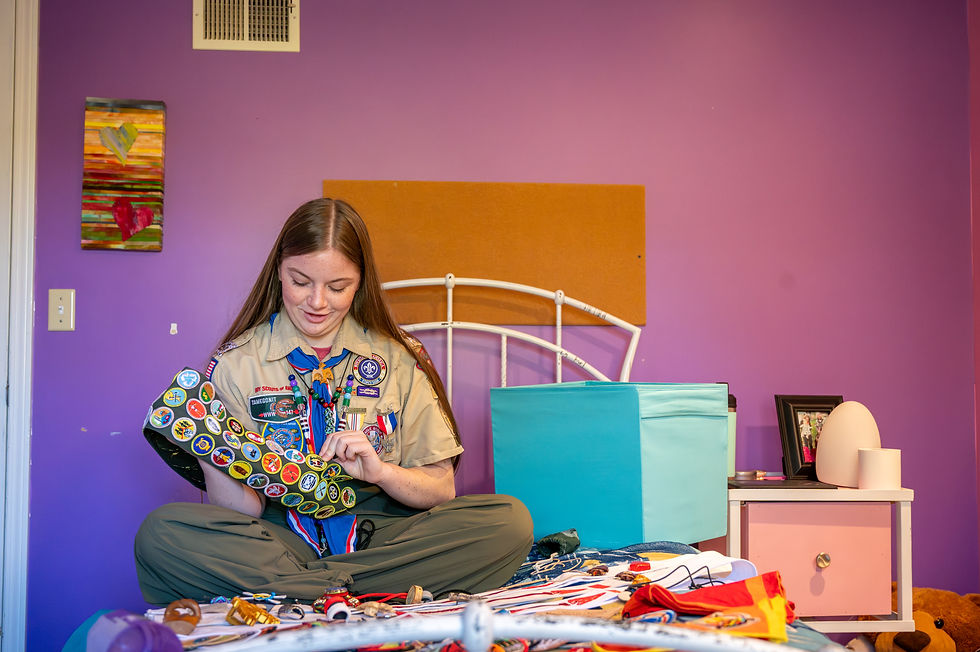
Senior Sienna Dehaemers looks at her merit badges Nov. 2, 2025, in her bedroom. Dehaemers has earned merit badges in scouts over the past five years by participating in extensive courses, projects and workshops. “I would say the coolest badges include sign signals, codes and nuclear science,” Dehaemers said.

Senior Olivia Perocho poses for a portrait Sept. 30, 2025, in the Rm. 151 photography studio. Perocho is overlaid with projections of screenshots of hateful messages from the 2026 graduating class senior group chat.

A JoCo resident stands to get his picture taken April 5, 2025, at the “No Kings Day” in downtown Kansas City, MO. Thousands attended, wearing pride flags, “The Handmaid’s Tale” costumes and in this case morale patches and a medal from time served in the military.
Senior Sienna Dehaemers looks at her merit badges Nov. 2, 2025, in her bedroom. Dehaemers has earned merit badges in scouts over the past five years by participating in extensive courses, projects and workshops. “I would say the coolest badges include sign signals, codes and nuclear science,” Dehaemers said.
My experience in taking portraits is primarily through environmentals. I think these are the most fun because it’s where your subject is naturally happy or comfortable. I want to get more experience in creating photo illustrations and utilizing different studio lighting techniques and equipment. I take many simple mug shots that are needed for our yearbook. And I’ve taken portraits for newspaper columns. I love looking for inspiration here and having conversations with writers or subjects about what environment, lighting, accessories and more best represent them. A lot of times people don’t know, so I’ll read their stories to generate ideas.
EVENTS

Jumping, freshman Asher Mesmer and sophomore Duncan Hirsch perform a choreographed routine during dress rehearsal for “Rodgers & Hammerstein's Cinderella: Enchanted Edition” Jan. 27 in the Auditorium.

Smiling, junior Kaili Szerwinski talks to the handmade mice puppets as Cinderella during dress rehearsal for “Rodgers & Hammerstein's Cinderella: Enchanted Edition” Jan. 27 in the Auditorium.

Clapping, junior Valentine Nielsen cheers for her friend as she graduates May 22, 2025, at Shawnee Mission North Stadium.
Jumping, freshman Asher Mesmer and sophomore Duncan Hirsch perform a choreographed routine during dress rehearsal for “Rodgers & Hammerstein's Cinderella: Enchanted Edition” Jan. 27 in the Auditorium.
The first thing I learned about shooting events was how important it is to always be the first and last person there. And also to never set your camera down or check your phone. When I’m not actively present and moving around or seeking different perspectives, my photos aren’t nearly as good. Some of my favorite events have been parades or protests because there are many opportunities to capture different moments and types of people. It’s also easier to stop people and interview them in those crowds, go unnoticed and get pictures that hold intense emotion. That’s also why I’ve learned it’s important to show up early, so that people get used to me in the space.