Introduction
I have been passionate about our website since joining newspaper my freshman year. It is the fastest and most accessible way of delivering content to readers. There’s also more flexibility from not having to work on a printer’s schedule, and it’s cost-effective. I appreciate the ways in which my staff has grown invested in pitching creative ideas and working with multimedia for our social media (TikTok and Instagram) and website. With a growing staff, publishing content online has also been a priority to ensure an equal distribution of assignments when print only has so much space. I am consistently dedicated to learning more about the features of our website, social media trends and how both can be used efficiently in sharing timely, interesting and evocative stories
Content

Back story: This story was written and reported in a day. I heard about the walkout once school started and remember our editorial leadership class gathering and discussing what coverage would look like. Who was actually going to walk out? What were they hoping to achieve? What did administration think? At noon, a couple of newspaper reporters and I waited in the lunchroom, seeing who would walk out. I spoke with the school principal and walked through the lunch tables, asking students if they'd planned on participating. It ended up being much less organized than people thought. A lot of students used the opportunity to go home or just leave school. Regardless, this was a great exercise and a taste of what online reporting should look like. Getting people the information of what actually happened, where and why, as soon as possible takes priority. This story also ended up being sent throughout class GroupMe’s and published on the Johnson County Post website.

Back story: I attended the balloon release for Ovet Gomez-Regalado, a sophomore on the football team who died due to a medical emergency at summer conditioning. Social media is an important tool for finding breaking news or story ideas. I got a message from my friend who screenshotted her friend’s Snapchat story, encouraging people to attend the balloon release. After seeing this the day before, I asked a photographer on my staff to attend. We arrived early, took notes, and spoke with students, football coaches, and friends scattered around our football field. Getting quick coverage on sensitive events can feel scary and intrusive. I’m approaching interviews and spaces respectfully, while also making it known that I’m a reporter. Transparency and empathy are traits that should be embodied and utilized in coverage like this.

Back story: My Editor-in-Chief early sophomore year, called me frantically to say there’d been a shooting at our local mall in Overland Park. I was confused and went to scour coverage online by local outlets. I found that one shot had gone off after an altercation between a shopper and a police officer, where they reached for his gun and pulled the trigger once. No one was harmed in this incident. I knew that a lot of people from my school, including myself, frequented this mall, shopped and worked there. We asked around if anyone knew someone there at the time and witnessed what happened. I found two girls who worked at the mall and heard everything. In school the next day, I spoke to her as she recounted hiding in Hollister’s back room with tears in her eyes. The story was published that day, getting both student accounts of what happened and summarizing and attributing coverage done by local reporters.

Back story: This story was reported, written and published in one day. There are no human sources for this story except for emails released by my principal informing families that NW senior Will Ensley had died in a car accident, giving condolences and offering resources for grieving students, teachers and faculty. I read through three news reports, which carried some discrepancies as to the time this happened, how many cars were involved in the pile-up, what caused it, etc. An obituary was published shortly after. It’s important that people have more information besides the email as to what happened. This was a very tragic event that sent waves throughout my community. Informing them and further providing mental health resources was significant.

Back story: I attended an SMSD board meeting and a protest regarding the racially charged assault of a student at Shawnee Mission East High School. The peaceful protest was organized outside our district building by the KC Defender, a digital newspaper covering racial issues and the Black Solidarity Network. Many local news networks came to cover the protest and speak with the injured student’s family. Getting in the huddle, asking her questions amid the noise, taking notes on what was being said/demanded and what would happen next was my role. I attended this event with a photographer and social media manager. Though I write about what’s happening at Shawnee Mission Northwest, this incident affected everyone in my district. It drew attention to specific policies, and Northwest students’ social media and conversations were flooded with details on the assault. This brings diversity and perspective to our coverage.

Back story: Since I’ve been in high school, there have been four students who’ve died throughout the course of 13 months. DeMarcus Houston, a transfer student from Shawnee Mission West High School, was one of them. After reporting on his life by speaking with friends and teachers, later on in an extended feature about gun violence in the KC Metro area, I’d learned that not many people at Northwest knew him. Houston kept to himself; he was shy. By publishing a news brief and obituary on Houston’s life and passing, this gave NW students a clearer understanding of who he was and how he died. I remember this story having some of the highest views according to our website analytics. Especially after finding out he was shot, which is unheard of in my area, students wanted to know more about how something like this could happen.
Back story: After CENTIGEX alarm boxes were installed by the district, a $2.6 million decision, false alarms were made for things such as fights or medical emergencies. During 7th hour on May 23, 2025, the alarm was triggered, and teachers and students were told to go on lockdown. Except this time, many people didn’t know this was a drill. I remember students in my classroom crying and hearing distant banging as students were also trying to get into the nearest classroom. Right after administration came over the intercom and reassured everyone, I went straight to the journalism room. Using video footage and recounts of the event from students, we summarized what had happened, previous accidents triggering these alarms and how and why our district decided to implement them. Students walked out of the building scared on their last day of school. We knew that needed to be in our ending, and to ask questions about how the district will go about preventing this. It was published less than two hours after school ended.
Online publishing


Since freshman year, I’ve been enamored with the idea of expanding our website. Going into sophomore year, I applied for online editor, but due to our incredibly small staff size, that wasn’t an option. Instead, I was made head copy editor for two years, and any changes made to our online was done in the free time of editors. I took a session on building our online presence at a fall conference in Boston and learned that what works for print doesn’t always, if ever, work for online. We shouldn’t be shovelling content from our print, but curating timely, online-specific content. We’ve begun implementing this over the last two issues, but I want to continue mapping out weekly deadlines for online content. Each week, there should be at least one entertainment piece (ex. Music, video game, movie, or food review), coverage on major sports events, breaking news as it occurs and an opinion (column or editorial) published and posted on social media. This also helps people meet their two assignment requirements as our staff size expands and there’s less room in print for everyone to write or design. Currently, my role with online is publishing and editing content, helping to create deadlines and assignments and managing analytics and visual elements.
Engagement
Polls
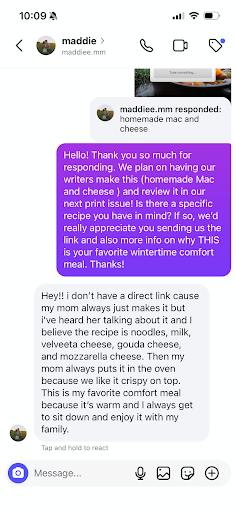
In order to find stories, get statistics or test the waters on story topics, my staff publishes polls through our publication’s Instagram. This account is followed by a substantial number of Northwest students, who give consistent responses. Questions could be regarding what their views are on emerging district policies (like those on cell phones), if they feel targeted in certain academic or social settings or how much caffeine they consume per day. These responses can help us generate alternative coverage and conceptualize how students at Northwest feel or know about something happening, who are being affected by what issues and help us find sources.


Reaching out to sources
Depending on the responses to a certain poll and if a reporter is having trouble finding sources through in-person interviews or outreach, we can contact student accounts through Instagram. There’s a simple formula that we provide to reporters, like if they were emailing or texting, but an editor or social media manager will send this message with approval from the Editor-in-Chief, seeing as they only have access on this account. From here, if they agree to an interview or would like to provide further information, they can give their contact information, which is forwarded, and scheduling/conversations proceed with reporters.